

Parisa, Co-Founder of My Village, shares her personal story of years of unexplained symptoms, inconclusive results, and what changed when someone finally connected the dots.
For years, I woke up at 3AM. Sometimes 1AM, 2AM, and 4AM too, like my body was running a schedule I never agreed to. I would fall asleep fine. Staying asleep was the problem. And over time it got worse: the wake-ups came with a wide-awake alertness that made falling back asleep impossible. I never woke up refreshed. I napped to survive my days.
And the sleep was only the loudest symptom. I started gaining weight in a way I never had before, and the methods that had always worked stopped working. I was working out more, eating more protein, and still gaining. My skin got drier. My heart would flutter and race out of nowhere, palpitations with no obvious trigger. Individually, each thing was easy to explain away. Together, they were telling a story.
And then there were the symptoms I didn't even think to mention in appointments, because I had absorbed them into my identity. The brain fog I blamed on stress and too many browser tabs. The histamine sensitivity that turned foods I had eaten my whole life into problems, which I treated as its own separate mystery, with its own elimination diets and its own supplements. Nobody asked me when it started. I never thought to connect it to my hormones either, even though estrogen and histamine are in constant conversation with each other in the body.
Looking back now, I wonder how long I was actually in perimenopause before I ever used the word. Years, probably. The changes were so gradual, and so easy to attribute to a demanding life, that I kept adjusting to a new baseline without noticing the baseline was moving.
That is the quiet cruelty of this transition: it doesn't announce itself. It arrives symptom by symptom, each one plausible on its own, until one day you realize you have been troubleshooting your own body in the dark for longer than you realize.
"You're too young for that"

Part of why nobody connects these dots earlier is a quiet assumption, held by practitioners and women alike, that perimenopause is something that happens later. It is not.
Perimenopause can begin as early as your mid-30s. (Cleveland Clinic) Early menopause, meaning menopause before age 45, affects about 1 in 20 women. (Cleveland Clinic) And a pooled analysis of 31 studies estimated that premature ovarian insufficiency, where ovarian function declines before age 40, affects 3.7% of women worldwide. (Cleveland Clinic Journal of Medicine) Research is also increasingly showing that timing varies by ethnicity, which means the "typical" age so many of us have in our heads was never typical for everyone.
These are not edge cases. In a room of 20 women, on average one will reach menopause before 45. Many more will spend years in perimenopause before that, starting well within the age range where "you're too young for that" still gets said. When that assumption goes unquestioned, women in their late 30s and early 40s get their symptoms attributed to stress, to lifestyle, to anything but hormones. The question is never asked, so the answer is never found.
The sleep study
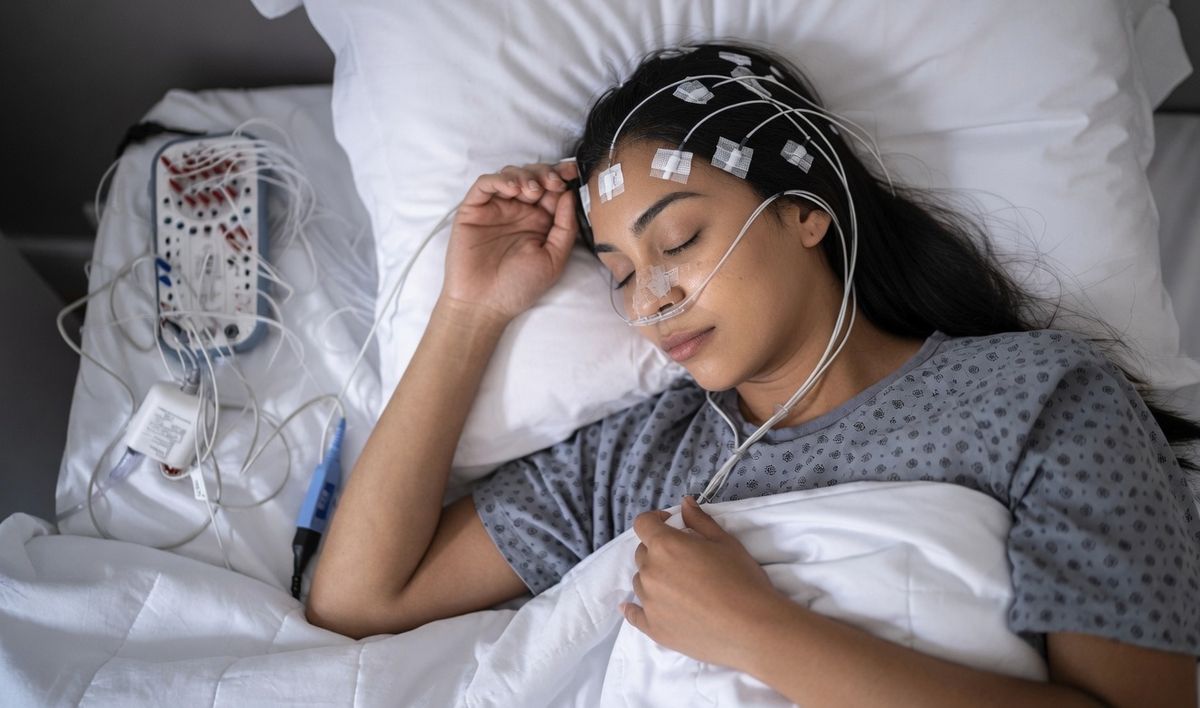
By the time I asked for a referral to a sleep clinic, I was waking up almost every hour, and after 3 or 4AM I would not fall back asleep at all. I had tried every sleep supporting method there was: bedtime restriction, limiting screen time, giving up caffeine entirely, a cool and dark room, all of it. The study itself came back inconclusive. To be diagnosed with sleep apnea, you need a score of five. Mine was 4.7. So close to a diagnosis that it explained nothing, and far enough that no one had to do anything about it. I left with a prescription for sleep medication and no long-term plan. The medication didn't even work on me.
Here is what stays with me. I was a woman in my early forties, describing sleep that fell apart gradually over a decade, wake-ups that got worse at certain points in my cycle, energy that had collapsed, unexplained weight gain, dry skin, heart palpitations. My mother went through menopause at 46. And in all of those appointments, with all of those experts, not one person said the word hormones.
This wasn't the first time
I know what it feels like to fall through the cracks of women's health, because it had happened to me before.
At 32, a gynecologist diagnosed me with endometriosis after an exam and a few questions. No imaging, no biopsy. I went on an IUD and the pain settled, so I filed it away. Years later, two different gynecologists looked at my ultrasounds and said there was no endometriosis. So which was it? Three doctors, two opposite answers, and nobody in between curious enough to dig deeper. It took my own research to learn that the most common form of endometriosis doesn't show up on a standard ultrasound at all. A clear scan and a real diagnosis can both be true at the same time. No one told me that. I had to find it myself.
And here is the part I want to be fair about. Each practitioner along the way was doing something responsible. The sleep clinic was right to rule out apnea. The gynecologists were right to check what an ultrasound can show. When you mention palpitations, of course your heart should be checked before anyone talks about hormones. Ruling things out is good medicine. I don't fault any single one of them for their piece.
But that is exactly the problem. Everyone ruled out. Nobody ruled in. Each specialist closed their own file and sent me on, and no one stepped back to ask what it means when a woman in her early forties shows up with broken sleep, weight gain that defies everything that used to work, dry skin, palpitations, and cycles that are shifting. All those responsibly checked boxes, all those loose ends, and nobody tied them together. What I was left with, over and over, was one word: inconclusive.
This is not a story about bad doctors. It is a story about a system that was never designed to connect these particular dots, especially when it comes to perimenopause and menopause. We need the sleep specialists, the gynecologists, the cardiologists. Every one of them plays a role. But we also need to recognize that when a system is not built or optimized for women's health at this stage of life, the connecting falls to us.
And this is documented, not just felt. Only about 31% of OB-GYN residency programs in the US have a dedicated menopause curriculum, and just 6.8% of residents across family medicine, internal medicine, and OB-GYN feel adequately prepared to manage patients going through this transition. (Healio, The Flow Space) The research gap runs even deeper: women were not required to be included in US clinical trials until 1993. (Davis Wright Tremaine) The practitioners I saw were working within a system that gave them limited training and an incomplete evidence base for this exact stage of a woman's life. That is a systemic gap worth talking about openly, not a battle between patients and providers. It is not an either or story.
Which is why my experience never felt like one dramatic failure. It was a series of shrugs. Inconclusive results, conflicting opinions, prescriptions without plans, and a woman left to reconcile it all on her own. Not because anyone failed to care, but because no one was positioned to see the whole picture.
Someone finally listened

The turning point wasn't a new test. It was a practitioner who listened.
My naturopath took the full picture seriously: the timeline, the cycle connection, my family history, the fact that I had already tried everything. Instead of another sleep tip, we investigated. A continuous glucose monitor showed that some of my wake-ups lined up with overnight blood sugar crashes, and adjusting my evening meals helped with those. But the deeper piece was hormonal. Progesterone, the calming, sleep-supporting hormone, is often the first to decline in perimenopause. It tracked with everything I had been describing for years.
I started a trial of progesterone. That first night, something I had stopped believing was possible happened: I slept. And I woke up feeling rested. The wake-ups have not disappeared entirely, they still happen once or twice a night, but now I fall right back asleep. After years of bracing for the 3AM alertness, my body started to trust sleep again.
I want to be careful here, because I am not saying progesterone is the answer for every woman. Every body is different, and what worked for me came after a thorough look at my full history, under the care of multiple practitioners. What I am saying is that in years of appointments, the possibility was never even raised. The most obvious explanation for a 42-year-old woman's disintegrating sleep was the one nobody mentioned.
My story is not rare. That's the problem.
This story is why My Village exists.
Perimenopause can begin years before anyone calls it that, and its symptoms scatter across specialties: sleep clinics, gynecology, gastroenterology, mental health. Each expert sees one slice. No one connects the dots, so the woman living inside the whole picture is told, over and over, that everything looks fine.
Tracking changed that for me. When I could show patterns, not just describe feelings, the conversation shifted. My symptoms stopped being anecdotes and became data. And data is harder to dismiss.
If your sleep has quietly fallen apart, if your test results keep coming back "inconclusive" or “normal,” if your gut is telling you something hormonal is happening and no one is engaging with it: you are not imagining it, and you are not difficult. You may be the only one looking at all the pieces at once.
Keep asking. Bring your patterns with you. And find the person who listens, because they exist, and one conversation with them can give you back what years of shrugs took away.
Related Articles
Perimenopause and Menopause at Work: Why Normalizing This Conversation Is Good for Everyone
Perimenopause and menopause are costing organizations their most experienced talent. Learn why workplaces need to normalize this conversation, what employers and HR leaders can do right now, and where to find free resources across North America and globally.
Advocating for Yourself at the Doctor's Office
Dismissed, misdiagnosed, or told you're "too young"? You're not alone. Here's how to prepare for appointments, ask the right questions, and make sure your perimenopause symptoms are actually heard.
Brain Fog in Perimenopause: What's Happening and What to Do
Forgetting words, losing your train of thought, struggling to focus? Brain fog during perimenopause is real, and it has a biological basis. Here's what the research says and what actually helps.